Appropriate Complexity: Designing specialist cardiac care in Rwanda
DOI:
https://doi.org/10.21542/gcsp.2026.41Abstract
Specialist cardiac care makes unusual demands on buildings. It requires a small number of tightly controlled environments in which intervention can be performed safely, and a much larger territory of ordinary spaces in which patients are screened, prepared, educated, rehabilitated and followed up for years afterwards. In low- and middle-income countries, hospital design has often responded by importing high-income specifications at a level of technical and constructional dependency that local building, procurement and maintenance capacity cannot always sustain.
The result can be a facility that opens at one standard but gradually settles towards the standard its context can actually hold - not through any single failure, but because of the accumulated drift of systems operating without the maintenance they require, adjacencies disrupted by later additions, and local capacity that the original design did not develop or enhance.
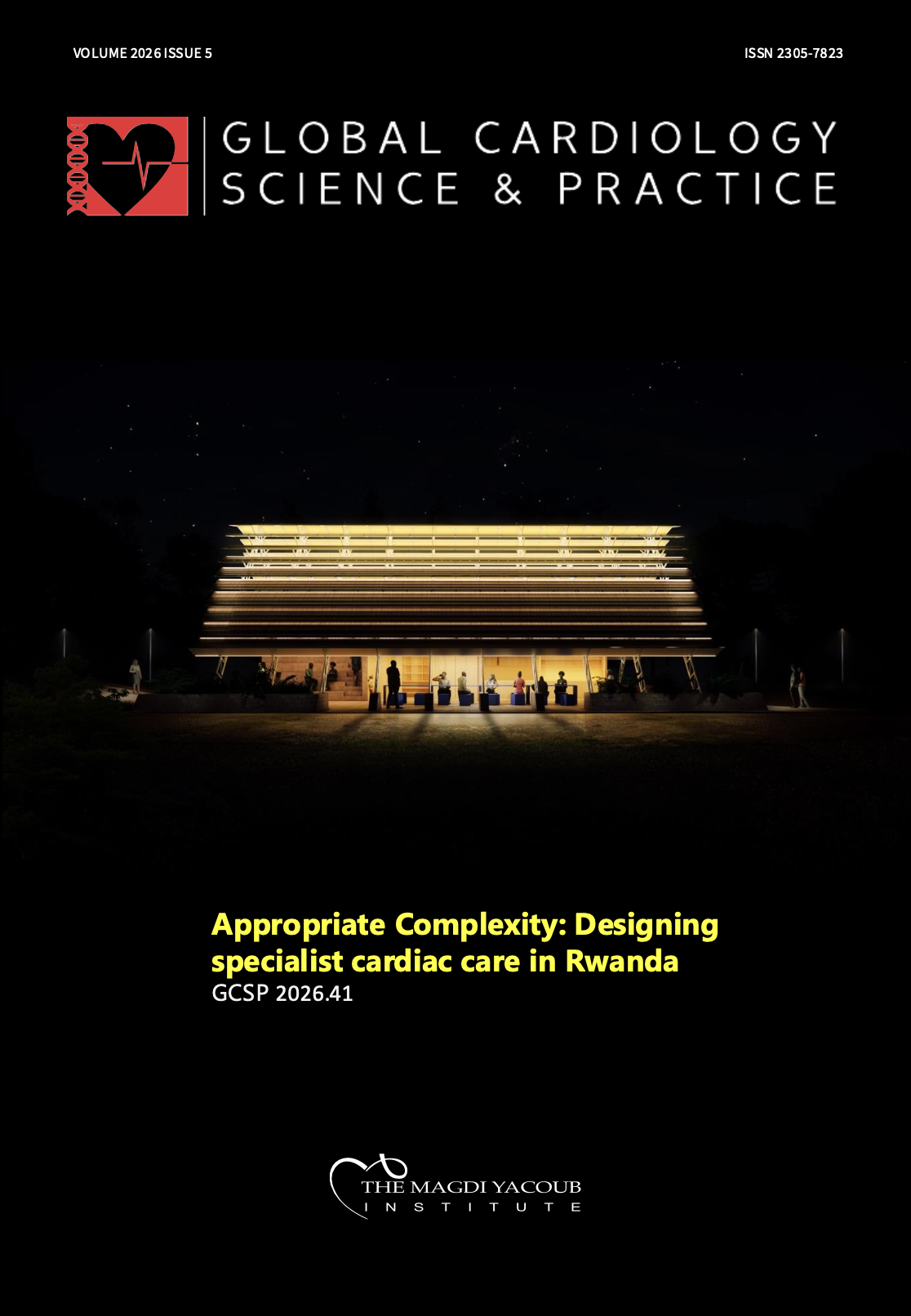
This paper reports the design of the Rwanda Egypt Heart Centre (REHC), now under construction in Kigali as the country’s first dedicated cardiac teaching, treatment and research hospital and conceived as a national and regional centre of excellence in cardiac care.
Building on the model established at the Aswan Heart Centre, Egypt, the project subsequently extends beyond the specialist hospital through the Village Integrated Plug-In (VIPI), a community platform combining preventive healthcare and patient follow-up with shared social, educational and digital facilities, designed for future integration with Rwanda’s national health data systems.
We analyse the design process itself as evidence, tracing how local and international clinicians, architects, policymakers and engineers arrived at key design decisions through project records, design iterations and co-design workshop deliberations.
From this analysis we introduce the concept of “Appropriate Complexity”: a framework for designing a centre of excellence in which the highest specification is located precisely where clinical intervention demands it, while the wider infrastructure is designed to be operated, maintained and adapted within its context. Complexity is therefore located rather than reduced.
Neither project is yet operational. We therefore present Appropriate Complexity as a design-derived hypothesis rather than as evidence of clinical or operational outcomes, and specify the post-occupancy indicators, reference points and assessment schedule against which it can be tested.
Downloads
Published
Issue
Section
License
Copyright (c) 2026 Julia Backhaus, Magdi H Yacoub

This work is licensed under a Creative Commons Attribution 4.0 International License.
This is an open access article distributed under the terms of the Creative Commons Attribution license CC BY 4.0, which permits unrestricted use, distribution and reproduction in any medium, provided the original work is properly cited.